Georgia 30-Hour Driver Education for Class D License
Learning to drive is one of those moments that feels like stepping into a new chapter of freedom. But in Georgia, it is not just about turning a key and hitting the road. Teens must first complete structured training to build safe habits early. That is where the Georgia 30-Hour Driver Education for Class D License becomes important.
This course is more than a requirement. It is a foundation for safe driving for life. It helps teens understand road rules, vehicle control, and real-world driving responsibility. In Georgia, this training is tied to Joshua’s Law, which was created to reduce teen driving accidents and improve road safety.
If you are preparing for your Class D provisional license, this guide will walk you through everything in a simple, friendly way.
What Is the Georgia 30-Hour Driver Education Course?
The Georgia 30-Hour Driver Education for Class D License is a state-approved online classroom program designed for teen drivers under 17. It fulfills the classroom portion of Joshua’s Law requirements.
Think of it like learning the “language of the road” before you actually join traffic. You are not just memorizing rules—you are learning how to think like a safe driver.
This course is fully online, which makes it flexible for students. You can study at home, after school, or even on weekends. Once you complete it, you receive an official certificate recognized by the Georgia Department of Driver Services (DDS).
Key highlights include:
- 100% online learning format
- DDS-certified training provider
- Required for Class D provisional license (teens under 17)
- Official completion certificate issued after finishing
Understanding Joshua’s Law in Georgia
Joshua’s Law is the legal backbone behind this training. It requires teens under 17 to complete driver education before getting a Class D license.
The law was created after a tragic accident involving a teen driver named Joshua Brown. His story led to a law focused on preventing similar accidents through better education and practice.
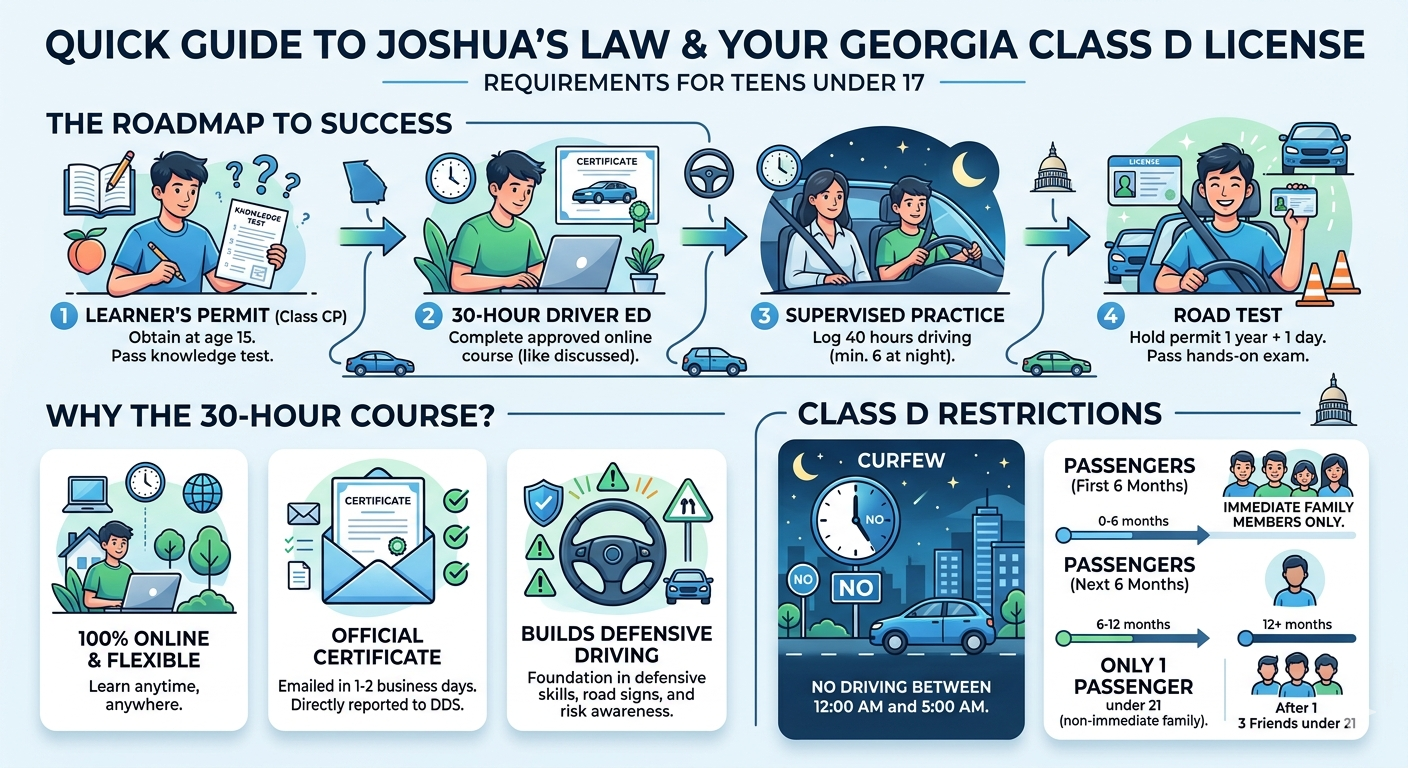
Under Joshua’s Law, teens must complete:
- A 30-hour classroom driver education course
- 40 hours of supervised driving practice
- At least 6 hours of night driving
The Georgia 30-Hour Driver Education for Class D License is the first step in meeting this requirement. Without it, teens cannot move forward in the licensing process.
Course Overview and Key Details
Before enrolling, it helps to understand what the course actually includes. Here is a simple breakdown:
| Feature | Details |
|---|---|
| Training Requirement | Meets Joshua’s Law classroom requirement |
| Approval | Georgia DDS-certified program |
| Format | 100% online learning |
| Certificate | Official DDS completion certificate |
| Purpose | For teens seeking Class D license |
| Support | Live chat customer support |
This structure makes it easy for students and parents to understand what they are getting. The Georgia 30-Hour Driver Education for Class D License is designed to be simple, flexible, and officially recognized.
What You Will Learn in the Course

The goal of the course is not just passing—it is preparing for real-life driving. The lessons are built in a way that feels practical and easy to follow.
Inside the Georgia 30-Hour Driver Education for Class D License, students typically learn:
- Basic vehicle operation and control
- Georgia traffic laws and road signs
- Safe driving habits and decision-making
- Defensive driving techniques
- Risk awareness and accident prevention
- Sharing the road with other vehicles and pedestrians
- Effects of distractions like phones or passengers
- Night driving safety basics
Each topic is explained in simple language so teens can easily understand and remember. It feels less like a textbook and more like real-life guidance from an experienced driver.
Why This Course Matters for Teen Drivers
Many teens think driving is just a skill, but it is actually a responsibility. This course builds that mindset early.
Here are some important benefits of completing the Georgia 30-Hour Driver Education for Class D License:
- Builds safe driving habits from day one
- Reduces risk of accidents for new drivers
- Helps teens understand real traffic situations
- Prepares students for both written and road tests
- Meets legal requirements for Georgia DDS licensing
- Improves confidence behind the wheel
One of the biggest advantages is confidence. When teens understand the rules clearly, driving feels less scary and more natural.
Step-by-Step Path to a Georgia Class D License
Getting a driver’s license in Georgia is a process, not a single test. Here is a simple roadmap:
Step 1: Get a Learner’s Permit (Class CP)
You must first pass a knowledge test and get your learner’s permit.
Step 2: Complete Driver Education
Enroll in and finish the Georgia 30-Hour Driver Education for Class D License course.
Step 3: Complete Supervised Driving
Practice driving with a licensed adult:
- 40 total hours required
- 6 hours must be at night
Step 4: Hold Permit for Required Time
You must hold your permit long enough to gain experience.
Step 5: Take the Road Test
Once ready, schedule and pass your driving test with Georgia DDS.
Step 6: Get Your Class D License
After passing, you receive your provisional license with certain restrictions.
Each step builds on the last one. Skipping any part is not allowed under Georgia law.
Course Completion and Certificate Process
After finishing the Georgia 30-Hour Driver Education for Class D License, students receive an official certificate. This certificate is essential for applying for the Class D license.
Here is how it works:
- Certificate is emailed within 1–2 business days
- Completion is reported directly to Georgia DDS
- Certificate must be taken to the licensing office
This process is automatic and simple. Students do not need to manually submit paperwork in most cases.
What Makes This Course Easy for Students
The design of this program is focused on convenience. Many teens already have busy schedules with school, sports, and part-time jobs.
That is why the Georgia 30-Hour Driver Education for Class D License is structured to be flexible:
- Learn at your own pace
- No classroom attendance needed
- Accessible on phone, tablet, or computer
- Easy progress tracking
- Support available when needed
It feels like learning in small steps rather than sitting through long, stressful classes.
Georgia Class D License Restrictions You Should Know
Once you complete the Georgia 30-Hour Driver Education for Class D License and pass your road test, you do not get full driving freedom immediately. Instead, Georgia issues a provisional Class D license with rules designed to keep teen drivers safe while they gain experience.
Think of it like training wheels on a bike. You are moving forward, but with some limits for protection.
Key restrictions include:
- No driving between 12:00 a.m. and 5:00 a.m.
- Limited number of passengers under a certain age
- Mandatory seat belt use for all passengers
- Zero tolerance for alcohol or drug use while driving
- Strict rules against phone use while driving
These restrictions are not meant to punish teens. They are meant to protect new drivers while they build confidence on real roads.
Common Mistakes Teens Make During Driver Education
Even though the Georgia 30-Hour Driver Education for Class D License is simple and online, many students still make small mistakes that slow down their progress.
Here are some common ones:
- Rushing through lessons without understanding
- Ignoring road sign meanings and details
- Not paying attention to defensive driving concepts
- Treating the course like a checklist instead of real learning
- Delaying completion until the last moment
One helpful mindset is to treat every lesson like you are already behind the wheel. Imagine how each rule applies in real traffic. That mental connection makes learning easier and more memorable.
Role of Parents in the Learning Process
Parents play a huge role in teen driving success in Georgia. Even after completing the Georgia 30-Hour Driver Education for Class D License, teens still need supervised practice.
Parents or guardians often act as:
- Supervised driving partners
- Safety coaches during practice hours
- Rule enforcers for safe habits
- Confidence builders during early driving experiences
A good approach is to make practice sessions calm and structured. Instead of long stressful drives, short and focused practice helps more. For example, one day can focus only on parking, another on lane changes.
When parents stay patient and consistent, teens learn faster and become safer drivers.
Why Supervised Driving Hours Matter So Much
The classroom portion of the Georgia 30-Hour Driver Education for Class D License teaches theory. But real skill comes from practice.
Georgia requires:
- 40 hours of supervised driving
- At least 6 hours of night driving
These hours are important because real traffic is unpredictable. No video or lesson can fully replace real experience.
During practice, teens learn:
- How to react under pressure
- How traffic actually flows
- How weather affects driving
- How to stay calm in unexpected situations
It is like learning to swim. You can read about swimming, but you only truly learn in water.
Tips to Pass the Road Test Easily
After completing the Georgia 30-Hour Driver Education for Class D License, the final challenge is the road test. Many students feel nervous, but preparation makes a big difference.
Here are simple tips:
- Practice basic maneuvers daily
- Learn parking until it feels natural
- Always check mirrors before turning
- Stay calm and avoid sudden movements
- Follow speed limits carefully
- Practice in different traffic conditions
One smart trick is to drive with feedback. Ask your supervising driver to point out small mistakes early. Fixing them before the test builds confidence quickly.
Quick Summary Table of the Full Process
| Step | Requirement |
|---|---|
| Step 1 | Get learner’s permit (Class CP) |
| Step 2 | Complete Georgia 30-Hour Driver Education for Class D License |
| Step 3 | Finish 40 hours supervised driving |
| Step 4 | Complete 6 hours night driving |
| Step 5 | Hold permit for required time |
| Step 6 | Pass road test |
| Step 7 | Receive Class D provisional license |
This simple path helps teens move step-by-step without confusion.
How Fast You Receive Your Certificate
One of the most convenient parts of the Georgia 30-Hour Driver Education for Class D License is the certificate process.
After finishing the course:
- Certificate is usually emailed within 1–2 business days
- DDS is automatically notified
- No manual submission is required in most cases
This makes the process smooth and stress-free. Students can focus on driving practice instead of paperwork.
Why This Training Improves Road Safety
The purpose of the Georgia 30-Hour Driver Education for Class D License is not only licensing. It is about saving lives.
New drivers are more likely to be involved in accidents due to inexperience. This course reduces that risk by teaching:
- Early hazard recognition
- Safe decision-making habits
- Awareness of distractions
- Respect for traffic laws
When teens understand risks early, they make better choices later. That is the real long-term value of this training.
Final Frequently Asked Questions
5. What is a Georgia Class D provisional license?
A Class D license is a restricted license for teens. It allows driving with limits until they gain full driving experience.
6. How do I complete behind-the-wheel training?
You must complete 40 hours of supervised driving, including 6 hours at night, with a licensed adult.
7. Is the Georgia 30-Hour Driver Education for Class D License fully online?
Yes, the classroom portion is completely online and can be completed at your own pace.
8. Can I start driver education without a permit?
No, you must first obtain a learner’s permit (Class CP) before completing supervised driving requirements.
Final Thoughts
Getting a driver’s license is more than a milestone. It is a responsibility that stays with you every time you start the engine. The Georgia 30-Hour Driver Education for Class D License is designed to prepare teens for that responsibility in a safe and structured way.
Instead of rushing, take your time with each lesson. Learn the rules, understand the risks, and build strong habits early. Driving is not just about reaching destinations—it is about making sure you and others arrive safely every time.
With the right training, patience, and practice, every teen can become a confident and responsible driver in Georgia.